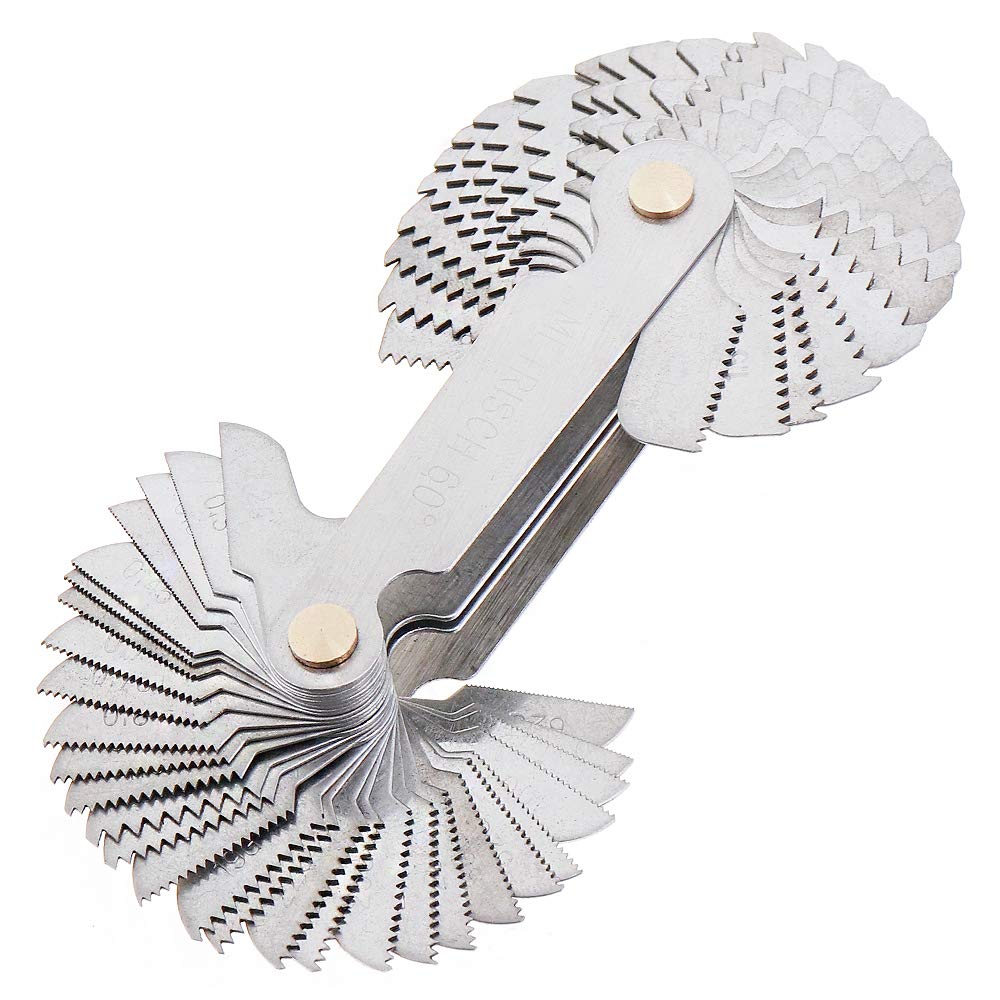
A thread and pitch gauge set is a tool used to measure the distance between threads (pitch) on screws, bolts, and nuts, or to determine the threads-per-inch (TPI). The set consists of multiple leaves with teeth profiles that match common thread pitches, and it is used as a reference tool to ensure threads will mate correctly. This is essential for proper assembly and preventing mechanical failure in manufacturing, repair, and fabrication.
Function and usage
- Pitch measurement: The primary function is to measure the distance between the peaks of consecutive threads. This is done by holding the gauge against the screw and finding the leaf with a perfectly matching tooth profile.
- Threads-per-inch (TPI) identification: For many fasteners, especially in imperial systems, the gauge will indicate the number of threads on a one-inch section of the screw’s shaft.
- Reference tool: A thread pitch gauge is not a precision measuring instrument itself, but rather a reference to identify the correct thread pitch and thread type for a given fastener.
- Ensuring compatibility: By identifying the correct pitch, users can select the right mating part (e.g., a bolt for a tapped hole), ensuring a proper fit and preventing issues like leaks or mechanical failure.
Set components
- Leaves: A set includes a number of folded, metal leaves. Each leaf has a specific number of teeth per inch or a specific pitch in millimeters.
- Markings: The leaves are typically marked with the pitch (e.g., 2mm, 4mm) or threads per inch (e.g., 10 TPI, 16 TPI).
- Common types: A good set will include leaves for a variety of common thread standards, such as Unified National Coarse (UNC), Unified National Fine (UNF), and ISO Metric, with different thread angles.
- Material: Gauges are often made from stainless steel for durability and to prevent wear.